
Every nascent disruptive technology is accompanied by claims that are based on lack of understanding, lack of data, and a fear of something unknown. This happened to the bicycle, the radio and the Internet. It has also happened with Bitcoin mining.
As research and data improves and as society starts to understand the technology more, a clearer picture emerges. But for this clear picture to fully emerge, the old picture based on our lack of understanding must atrophy.
This document provides evidence-based responses to the most common factually incorrect claims that are still circulating about Bitcoin mining and energy. It is an essential starting point for any regulator, policy-maker, journalist or curious individual who is sincere about making sure their beliefs and knowledge is well-grounded.
1. “Bitcoin uses a lot of energy/water/eWaste per transaction”
Not true.
This claim is dismissed in four peer-reviewed studies (Masanet et al., 2019; Dittmar et al., 2019; Sedlmeir et al., 2020; and Sai and Vraken, 2023) as well as by Cambridge University because Bitcoin’s resource use does not come from its transactions.
This means that Bitcoin transaction volume can scale without increasing resource use (energy, water, electronics). The claim originated from Alex de Vries’ 2018 non-empirical 5-page commentary “Bitcoin’s Growing Energy Problem,” whose per-transaction basis was debunked in full studies but widely media-cited, causing pervasive misunderstandings. De Vries initially measured energy per transaction but later extended this to the equally invalid method of measuring eWaste, emissions and water use per transaction.
On the point regarding eWaste, in 2025 Cambridge demonstrated that de Vries’ total estimated eWaste numbers were overestimated by 1204% (2.3 kT eWaste, not the annual 30 kT eWaste claimed by de Vries), invalidating de Vries’ claim that Bitcoin mining had an eWaste problem. Source. For what happens to Bitcoin mining rigs once they retire, read What really happens to old Bitcoin mining rigs?
2. “Bitcoin mining destabilizes grids”
In fact, there is a fast-growing body of independent research which shows that Bitcoin mining stabilizes grids due to its unique flexible, modular and interruptible nature. This stabilization impact has been felt most strongly on grids that are transitioning to higher concentrations of VRE (Variable Renewable Energy) such as solar and wind.
For example, a whitepaper from energy experts at Duke University concluded that Controllable Load Resources (aka: Bitcoin mining) help to stabilize grids and defer expensive grid upgrade costs.
Lai et al found that Bitcoin mining can “balance the electrical grid”
Ibañez et al concludes “PoW mining emerges as an alternative that can provide ancillary services (auxiliary services designed to provide stability to the energy grid)”
Menati et al demonstrated that “the flexibility of cryptocurrency mining loads plays a pivotal role in the reliability of electricity systems” and “cryptocurrency mining…is shown not to be detrimental to power grid reliability even with significant amounts at certain locations.”
These scholarly works are backed up by real world data from ERCOT, the grid which houses the largest concentration of Bitcoin mining.
On the ERCOT (Texas) grid, the evidence shows Bitcoin mining acts predominantly as a grid-stabilizing force. It provides near-daily stabilization through Frequency Regulation and Demand Response services. There have also been several large-scale emergency events where Bitcoin mining stabilized the grid, the major documented case being Texas’ July 2022 heatwave. In contrast, ERCOT has documented one (mild and localized) grid-destabilizing incident which Bitcoin mining impromptu load-shedding contributed to on April 25, 2024. Therefore, over a multi-year period, large-scale grid stabilization events significantly outnumber destabilization events, with the latter consisting of a single case.
Former ERCOT interim CEO Brad Jones summarized ERCOT’s findings: “[Bitcoin mining operations] have found a way to come into the market and take some of that excess wind in offpeak periods. Then it can turn down whenever we need the power for other customers… And if a generator trips offline, it can very quickly respond to that frequency disruption and allow us to balance our grid more efficiently.”
3. “Everyday consumers pay more for electricity because of Bitcoin miners”
Not so.
First, let’s look at the data: between 2021 and 2024, total electricity costs paid by US citizens rose from $200.80 billion to $250.33 billion (24.67%), or 7.7% when inflation adjusted.
Now let’s contrast this with the part of the US where there was an anomalously high concentration of Bitcoin mining: Texas. In Texas, between 2021 and 2024, total electricity costs paid by residential customers in Texas rose from $21.23 billion to $26.29 billion (23.8%), or 7.0% when adjusted for inflation.
Neither in the data, nor in peer reviewed study is there evidence to support the claim. There are however five key ways that Bitcoin mining has been found to help lower prices. These being:
- Monetizing renewable energy that would otherwise have been wasted
- Creating a more competitive market for Ancillary Services
- Obviating the need to purchase additional gas peaker plants
- Reducing, and in some cases removing, curtailment fees
- Deferring the need for new grid infrastructure costs
I explain how each of these mechanisms works in more detail in this article
Brad Jones, Former Interim CEO of Texas’ grid ERCOT observed“the capability for [Bitcoin Mining] to meet our ancillary services at the lowest possible cost means lower costs for all consumers in the State of Texas.”
So the question arises, why did we not see an anomalously low increase in Texan power prices? One reason for Jones’ statement could be that Texan price rises could have been much higher. For example:
After the 2021 blackouts, a major solution proposed was building gas peaker plants (the Berkshire plan and later Senate Bill 6), estimated to cost $18 Billion. Instead, ERCOT integrated Bitcoin miners as a large (reportedly up to 3 GW), flexible load that can rapidly reduce consumption during grid stress, replacing the need for additional flexible generation with additional flexible demand.
There are two documented cases of the cost-impacts of Bitcoin mining on the grid exist, in Norway and Kenya.
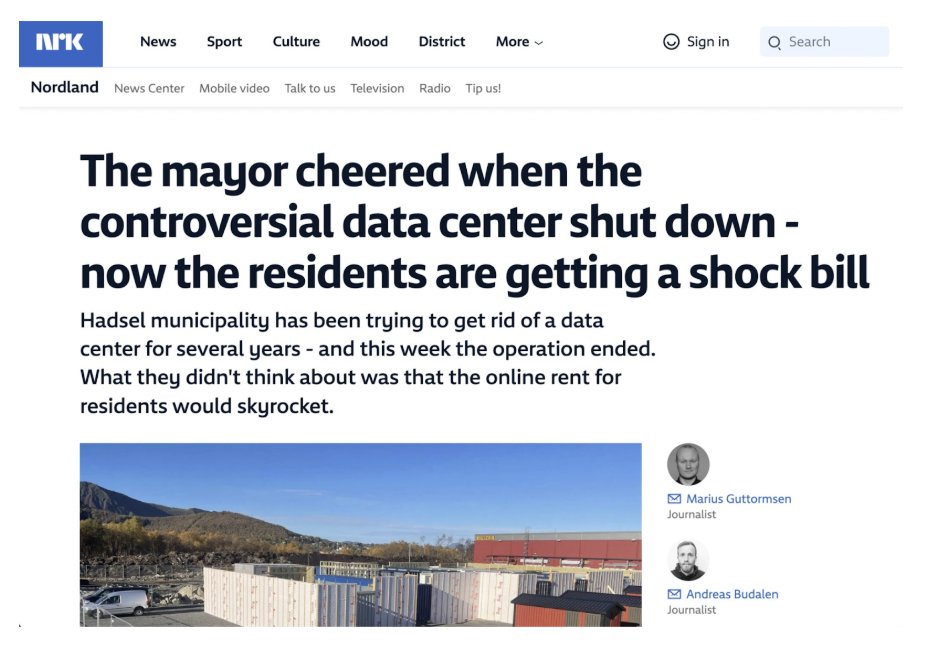
In Sept 2024, Norwegian residents realized that Bitcoin mining had for years been keeping their power prices 20% lower, after the Bitcoin mining operation left the grid and their prices instantly increased to compensate for the revenue shortfall.
Then, CNBC reported that the addition of a Bitcoin-mining to a rural microgrid in Kenya “dropped the price of power from 35 cents per kilowatt hour to 25 cents per kWh” (a 28.5% price reduction) by monetizing previously wasted hydro-energy.
As Bitcoin mining integration onto grids expands, we expect more such cases to get reported.
4. “Bitcoin uses too much energy”/ “Bitcoin uses as much energy as whole countries”
Cambridge University states that comparing industries to countries is not meaningful, has a tendency to result in misleading portrayals and is an example of “presenter bias”.
Critically, the consensus within mainstream environmental science and policymaking focuses on transforming the energy system, not on reducing total energy use.
This is even written into the IPCC’s assessment reports, which represent the broad scientific consensus, and which outline a pathway that requires a major shift in how energy is produced and consumed, not a blanket reduction in use. Key changes include:
- A rapid shift to low- and zero-carbon energy sources and a large increase in electrification (e.g: electricity supplying 48–58% of final energy by 2050, up from 20% in 2019).
- Greater system flexibility, integration, and energy efficiency – not simply less energy.
- Substantially reduced fossil fuel consumption, with a focus on mitigating methane emissions from oil, gas, and coal operations.
All three key changes recommended by IPCC are features of Bitcoin mining
- Already fully electrified, meaning no direct emissions.
- Not only highly flexible, but appears to be uniquely capable among major energy consumers of meeting the specific trifecta of: (1) shutting off its entire load, (2) restarting it, (3) within a 500ms timeframe, without relying on external energy storage. This ability is increasingly important according to IEA, as our percentage of intermittent power-sources on the grid increases.
- Capable of profitably mitigating methane emissions from landfills and the Oil and Gas sector at scale.
5. “Bitcoin’s carbon footprint is <some variation of “very high”>
Bitcoin mining is in fact the only global industry for which there is robust, third-party data showing it has crossed the 50% sustainable energy threshold. Given that the global average grid mix is approximately 40% renewable, and in the absence of comparable industry-wide energy mix data for other major sectors, it stands as a uniquely documented case of achieving this milestone at a global scale.
Cambridge’s April 2025 report placed Bitcoin mining emissions at ~39.8 MtCO2e attributable GHG emissions.
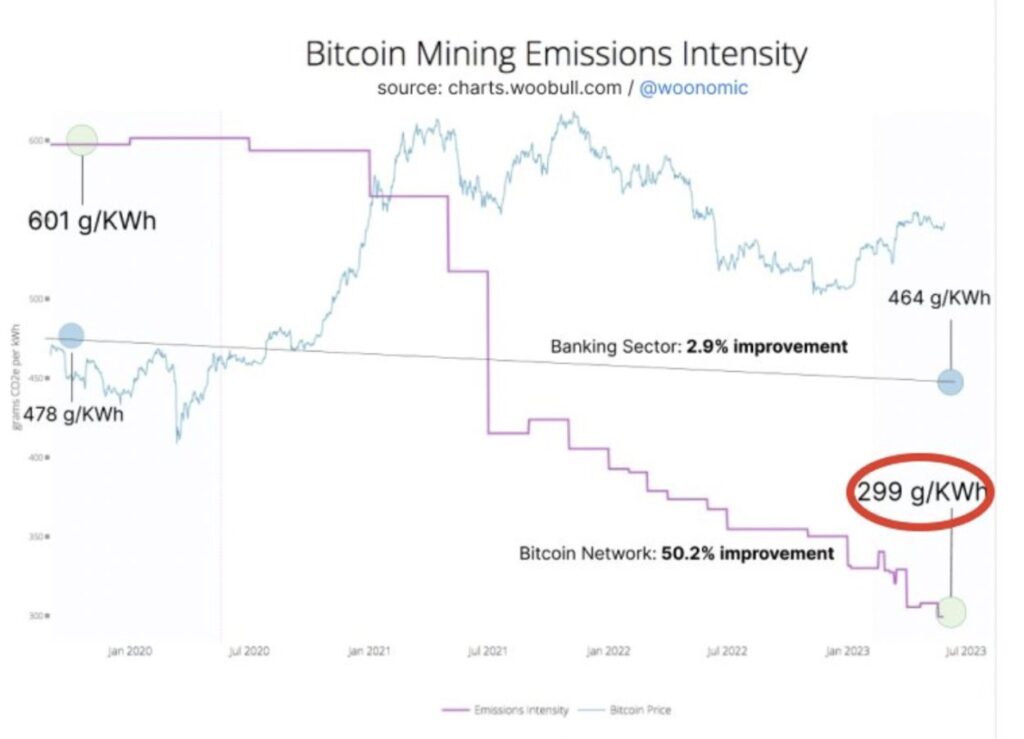
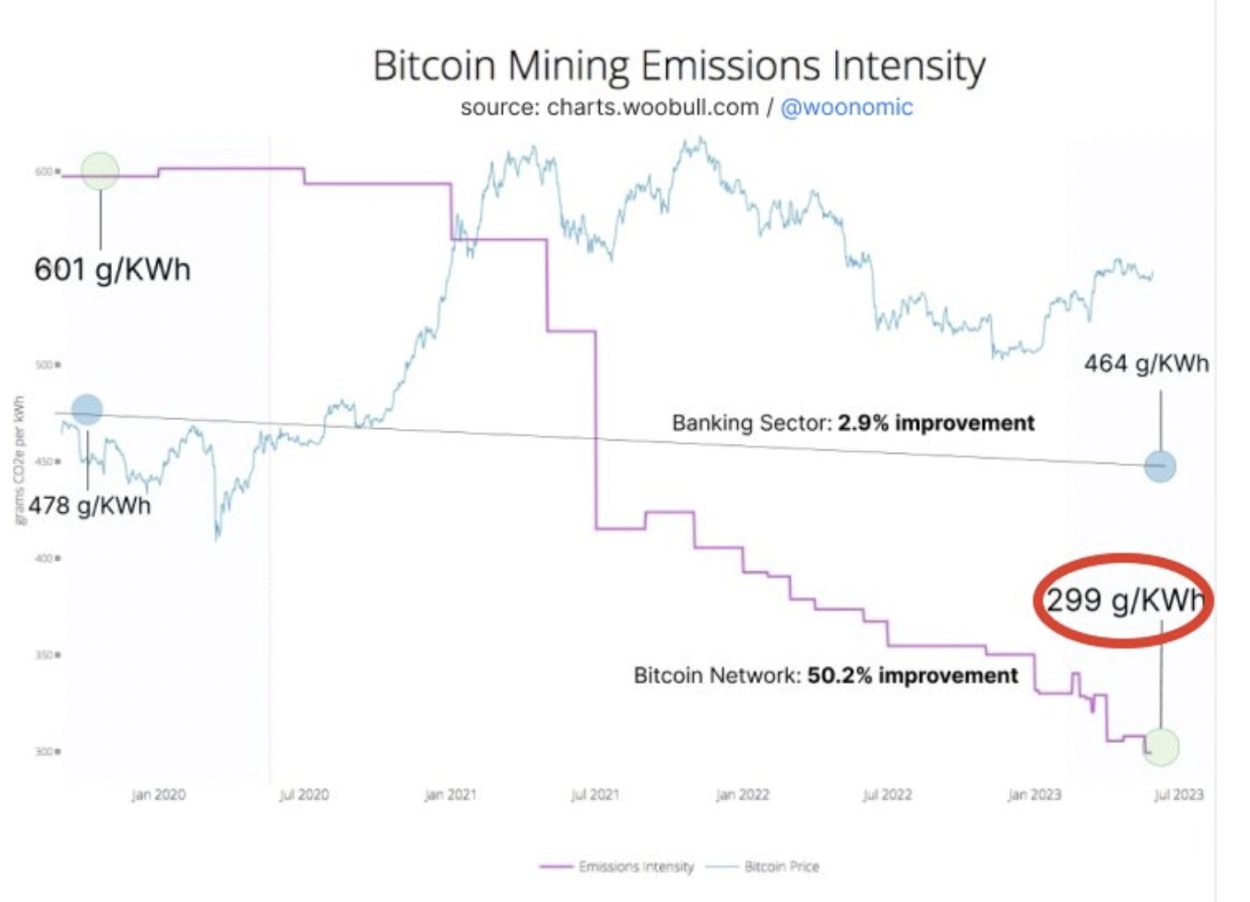
Like electric vehicles (EVs), Bitcoin mining has no direct emissions, only scope-2 emissions from electricity usage, and obviates a more emission-intensive technology (the banking sector; see chart below).
EVs accounted for 80 Mt CO2e attributable GHG emissions in China and the US alone, but this statistic is never presented in isolation. Similarly, presenting Bitcoin mining’s emissions without noting they are scope-2 and without referencing the more emission-intensive industry it replaces is highly misleading.
Cambridge data is very clear on this point, attributing these emissions solely to scope-2 electricity usage, not scope-1 direct impacts: “electricity usage of Bitcoin mining activity at approximately 138 TWh, resulting in around 39.8 MtCO2e attributable GHG emissions.”
The chart below shows Bitcoin mining has lower emission intensity and faster intensity improvements than the banking sector it obviates.
Note: Cambridge’s December 2025 survey lowers Bitcoin’s emission intensity to 252 g/kWh.
So in summary, claiming Bitcoin has a high carbon footprint is like claiming that EVs have a high carbon footprint: materially misleading.
6. “Proof of Stake (Ethereum) is better for the environment than Proof of Work (Bitcoin)”
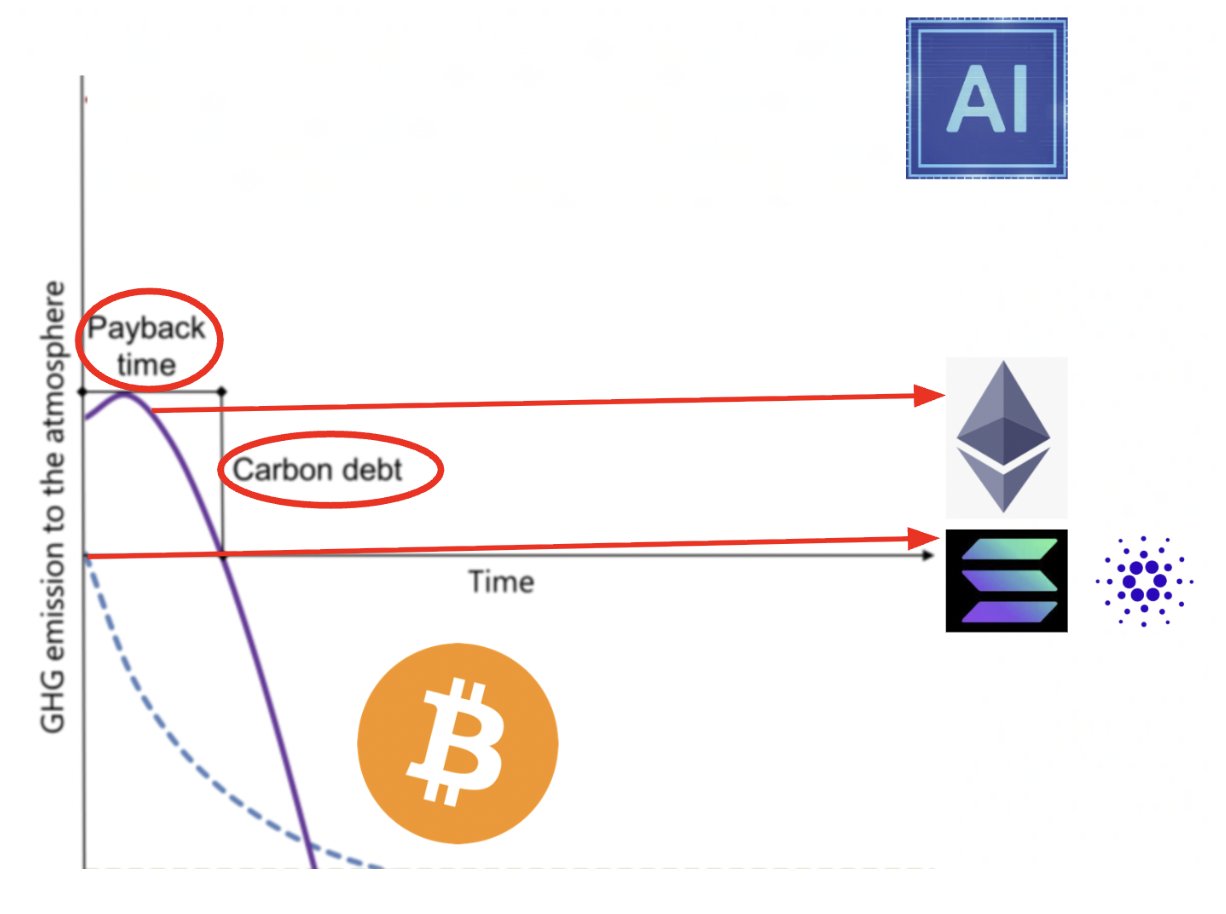
Bitcoin’s PoW uses vastly more energy than Ethereum’s PoS. But claiming this makes PoS more environmentally friendly errs by conflating energy use with harm, something environmental scientists and policymakers’ consensus says we cannot assume.
Bitcoin’s Proof of Work algorithm means that the Bitcoin energy use can and has resulted in the proven ability to mitigate methane, provide stability to the energy grid, increase renewable energy capacity, monetize wasted renewable energy, support renewable development and climate action, or facilitate clean microgrid development, as demonstrated in the linked peer-reviewed research and independent reports.
Ethereum lost the capacity to deliver these environmental benefits when it moved from Proof of Work to Proof of Stake in Sept 2022.
Cambridge’s latest survey puts Bitcoin’s methane mitigation at 4.69 MtCO2e a year (December 2025), about 11% of the network’s total emissions on BEEST 2’s latest figures (reducing methane emissions from the O&G industry that otherwise would have gone into the atmosphere).
Source: Cambridge Digital Mining Industry Report, 2nd edition, preliminary results
Methane’s high global warming potential means even small-scale power generation from flared or vented gas yields major emission reductions. Thus, no barriers prevent Bitcoin mining from exceeding 100% mitigation in the future, potentially abating more emissions than it produces via methane alone (notwithstanding the additional obviation of the more emission intensive banking sector).
Bitcoin mining qualifies as climatetech for its emission abatement capabilities. Under Proof-of-Stake, however, it couldn’t deliver the benefits cited in 32 peer-reviewed papers and 8 reports, which stem from its flexible, energy-intensive Proof-of-Work mechanism.
7. Bitcoin mining is not responsible for mitigating methane, because “you could use landfill gas/flaregas for things other than Bitcoin mining such as …”
Claiming you could use stranded methane from landfills and oilfields is at once both technically true and economically infeasible. It is in the same category of statements as:
“You could harvest electricity from human body heat to power small devices or contribute to grid energy.” or “You could build a space elevator from carbon nanotubes to transport cargo and people into orbit without rockets.” Both of these statements are logically true, but economically infeasible, at least today.
Similarly, there are many things that could theoretically be done with the methane emissions on grid-and-pipeline-stranded oilfields and landfills. However, similarly, none of them have proven cost-effective, which is why they have not occurred.
However, unique to Bitcoin mining, ~80% of its operation costs is electricity. This means that there is a very strong economic incentive to find the cheapest form of electricity, even if it is remote, hard to access and involves capital expense to harness.
This is backed up by one of the world’s LFGTE and LFG Carbon Credits experts, Nuno Barbosa, CEO of Unicarbo who stated
“50% of the world’s landfills have no option to sell their power back to the grid, but if they had an onsite customer, that would change everything.”Interview Source
Barbosa also stated.
“Landfill gas infrastructure is capital intensive so EV charging stations, while a nice idea, seldom pencil out economically, certainly not as an initial user of landfill gas. Nor do biogas refineries unless the landfill is very big or there is some government subsidy for it.”
Nuno Barbosa – CEO, Unicarbo
8. “Bitcoin mining takes away renewable energy from other users/ could be used for ‘something better’”
This is not supported by evidence, and contradicts the inbuilt economic incentive mechanism which disincentivizes Bitcoin mining companies for using power when wholesale electricity prices spike (ie: there is high contention for that power).
Bitcoin mining because of its inbuilt economic incentives to use cheap power is, as former ERCOT Grid operator Brad Jones attested, a “non-rival energy user”. In other words, it powers down when the price of power becomes too expensive; the very time other people want/need that power.
There is however evidence that the opposite of the claim is true, ie: that many people now have access to renewable energy who otherwise would not have as a direct result of Bitcoin mining. For example, Gridless in Africa has delivered renewable energy to four villages (an estimated 28,000 people), while on a much bigger scale in Ethiopia, there is strong evidence from EEP data that Bitcoin mining has helped accelerate the building of transmission lines to deliver renewable energy to rural communities.
In terms of the “use for something better” argument, because Bitcoin mining seeks out the cheapest energy, much of this energy is stranded and unable to be utilized by other users due to its remote location, unattractive time of day, or both.
The argument that Bitcoin mining takes energy that could be used for something better is like saying “if we took all the crumbs eaten by ants each year, we could feed a small African nation.”
It is also an implicit value judgment about how we “should” use energy, often made in the absence of investigation of Bitcoin’s rapidly growing list of uses. There are now 21 documented environmental and humanitarian uses that Bitcoin currently has. Without awareness of how Bitcoin is increasingly used to deliver important and well-documented social and environmental benefits, we cannot legitimately claim that using energy for bitcoin mining could be better served for AI, Netflix or any number of other uses.
9. Bitcoin mining “wastes energy”
This is not an accurate assessment because there is significant peer-reviewed literature and case studies showing where bitcoin mining has prevented the waste of renewable energy.
For example, Moghimi et al found that traditional Microgrids produced a large amount of excessive energy, which is wasted without usage due to mismatch between renewable generation and demand. However when Bitcoin mining was integrated it prevented almost all energy waste, while decreasing microgrid operating costs by 46.5%.
Similarly, Lai and You found that Bitcoin mining prevented the significant waste of power often associated with wind and solar due to being produced at the wrong time of day, or in the wrong location without adequate transmission capacity. They found that “Leveraging crypto as virtual carriers can enhance renewable capacity and potentially achieve up to 98% and 92% utilization of available solar and wind power, respectively.”
Further, “wasting energy” is not an objective assessment, but a value judgment. One can only claim that energy is wasted if no good to humanity is produced in the process. As we’ve already seen in the point above, there are 21 well-documented benefits rendered possible by bitcoin mining’s Proof of Work Algorithm: a remarkable achievement for a technology which is only 17 years old.
Pingback: Bitcoin e-waste: what really happens to old Bitcoin mining rigs?
Pingback: The new (data-backed) story about Bitcoin mining - Batcoinz
Pingback: Orange-pilling the early majority - Batcoinz
Pingback: Bitcoin energy per transaction: why it's the wrong measure
Pingback: Improving our estimate of Bitcoin energy consumption - Batcoinz
Pingback: New insights on Bitcoin mining and sustainability - Batcoinz
Pingback: Rebuttal of BBC News article, and the underlying study, on Bitcoin water usage - Batcoinz
Pingback: 10 images that forever changed our perceptions about Bitcoin and energy - Batcoinz
Pingback: Accurately, dynamically calculating Bitcoin network emissions - Batcoinz