In an earlier report we saw how 329,000 refugees had used Bitcoin to set up their lives in a new country.
After that was released, I got a message from a stranger saying “Thank you so much for your report. I’m one of them.” I asked if he would like his story to be shared here and he generously agreed. Warning: what follows is the incredible, sometimes heart-wrenching, story of how “the other half lives” in ways we can barely begin to imagine, and how Bitcoin is making a real difference to their lives.
Imagine waking up one Saturday morning to find that the money you’ve saved for decades is worthless. Not worth less, actually worthless – because the government decreed without warning you that it was no longer legal tender.
No problem, I still have my money in the bank right? No. This is Burma in 1987. The banking system is virtually non-existent. You have your savings in pieces of paper currency, stored securely in your home. Now those pieces of paper are literally just pieces of paper.
That nightmare became a reality for many in Myanmar (Burma) on September 5, 1987. Out of the blue, Ne Win, the country’s military-backed ruler, demonetized the 25, 35 and 75 kyat notes (that is, made them worthless by decree overnight).
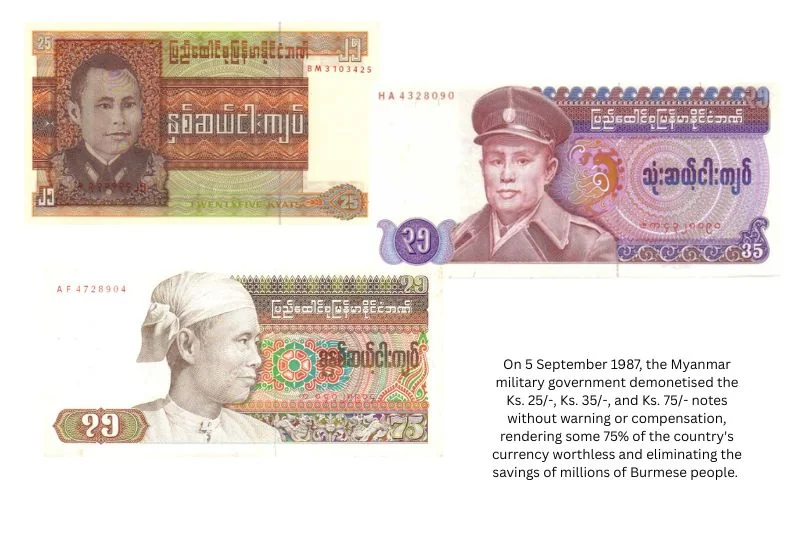
The move made around 80% of the money in circulation worthless. In an era when banks were seldom used for saving, many Burmese citizens saw their life savings evaporate overnight. Of course, if you were an insider with close ties to the ruling military, you would have received a tip-off and already converted your Burmese cash into hard assets like gold and real estate.
This demonetization laid the foundation for decades of economic instability. In the case of Win Ko Ko Aung, born six years later, it meant he was born into poverty. That was a direct result of the ruling government’s control of the monetary system (a power that democratic governments also have, but most people trust them not to use).
Despite growing up in the central commercial city of Yangon and gaining early exposure to the Internet, his life was defined by control. Electricity was intermittent, and the government held a monopoly over telecommunications. Internet access was prohibitively expensive and restricted, with the regime actively spreading propaganda that discouraged youth use.
Hope arrived in 2011 with the transition to a democratic government, followed by the historic visit of President Barack Obama the next year. Inspired by the changing landscape and the influx of multinational companies that ensued, Aung decided to forgo the path of many peers, moving to countries like Singapore or Korea for more stable currency income. However, he ended up participating in the nation’s democratic revolution.
In 2018, he was selected as the Southeast Asia Youth Leader and got an opportunity to travel to the USA for a 3-month fellowship. Once there, he taught Internet and digital literacy to African American kids in South Chicago.
Coming back from the USA inspired, he established a successful digital technology company promoting literacy across the country. He was making an impact in society while earning a good income. However, he couldn’t see a great financial future against the backdrop of currency devaluation. As he recounts:
“I was making money, not in USD or in Singapore dollar, but in Myanmar Kyat, which is like melting ice cubes. I was making money, but mathematically speaking, I was never going to be able to buy a house, unless I would make a 100% increase in income, year after year.”
To preserve his wealth, he initially explored gold (too inconvenient to redeem) and savings in USD in a bank account. Though he had previously dismissed Bitcoin in 2015 and 2017 after encountering negative mainstream media coverage, his desperate need for a stable financial solution compelled him to investigate decentralized digital assets. He eventually invested a portion of his savings across Bitcoin and other digital assets.
The digital silencing of dissent
On February 1 2021, government intervention changed the trajectory of Aung’s life for a second time. The Burmese military staged a coup, erasing a decade of democratic progress. Aung, now a social entrepreneur with over 500,000 followers on his Facebook page, was one of the leaders in the decentralized democracy movement. He used his following to marshal followers to protest the military takeover.
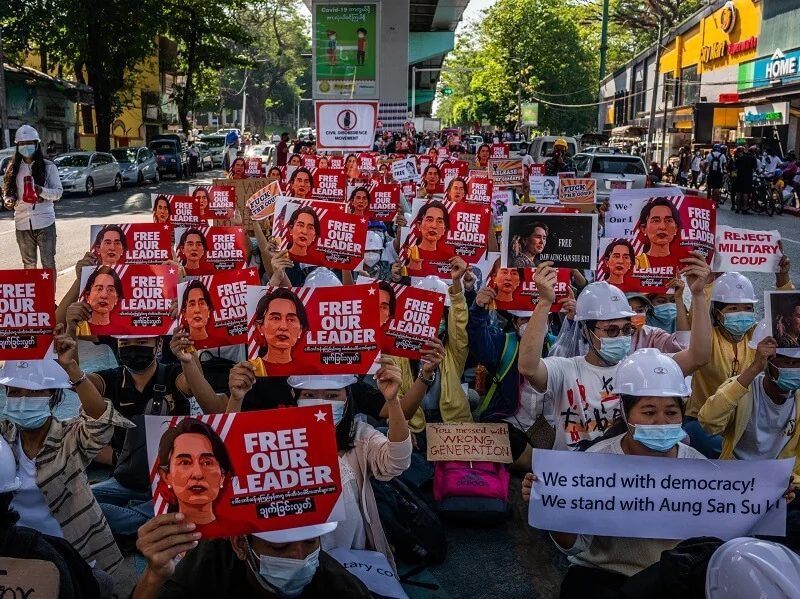
The military junta weaponized the centralized financial system to exert control over Aung and others. Aung awoke one day to find he had been locked out of his bank account, losing all his USD savings.
Happily, his Bitcoin and other digital assets remained safe because the government couldn’t gain access.
Other major voices in the movement faced similar lockouts or outright arrest. Supporters who donated $8 or less to the pro-democracy movement were sentenced to seven to ten years in jail.
By April 2021, Aung was on the country’s Most Wanted List. Fearing for his life, he fled, crossing the border into Thailand and seeking refuge. He was later granted asylum and resettled in the United States, where his advocacy continued. However, an interview with Voice of America, conducted in the Burmese language, alerted the military to his continued activism via his Facebook platform.
The regime responded by arresting his elderly mother. Her freedom was eventually negotiated on two explicit conditions: that Aung cease his advocacy activities and, most critically, that he delete his Facebook account. Fearing for his mother’s safety, he abided – losing all 500,000 followers instantly. This silenced his primary digital platform. It was an illustration of the authoritarian playbook: weaponizing financial and family ties to suppress dissent.
A tool for human rights advancement
In the US, Aung secured menial jobs but simultaneously deepened his understanding of Bitcoin. He later joined the Human Rights Foundation, shifting his focus to international human rights and Bitcoin advocacy, which he has done since.
Today, Aung is one of the hundreds of thousands of refugees who have been able to use Bitcoin to preserve and transport wealth during crises. He notes:
“I support Bitcoin, especially for activists and democracy movements, because with other cryptocurrencies, you need to constantly worry. There are a lot of risks. You’ll be worried about what their marketing team is going to do, what the founder is going to do. A lot of political influence also impacts the assets, and governments can block transactions to activists.”
To him, Bitcoin represents freedom, particularly for those under oppressive regimes. Its uncensorable nature makes it uniquely suited for activists and decentralized movements, allowing for support and communication that cannot be easily blocked or seized by state authorities.

More importantly, his journey led him to a crucial realization. Stablecoins (digital tokens pegged to a currency such as the US dollar) also offered a way to preserve value. But Bitcoin’s true decentralization means it has no single founder or central entity that governments can identify and compel to enforce their will. That is a significant advantage over other digital assets.
Having personally experienced the effects of monetary collapse, real-time asset demonetization, and the total loss of all personal savings, Aung’s trust in Bitcoin is born out of experience and necessity, not ideology. Furthermore, his firsthand experience of starting a new life in a new country was immediately supported by Bitcoin donated by fellow advocates, empowering him to get on his feet faster. The stories of people like Aung show us that Bitcoin is much more than an investment – it is a tool for human progression, a bulwark against authoritarian control.
So the next time you hear someone say “Bitcoin has no use” – know that what they are actually saying, whether knowingly or unknowingly, is “The lives of people like Aung don’t matter.” The viewpoint is not progressive, it is reactionary: born out of either prejudice, ignorance, or a failure to extend either their imagination or their cognitive bandwidth outside of their Western bubble of comfort and privilege.
Don’t get angry with such people, after all I used to be that ignorant person myself. Rather, educate them with stories like this one that show the gaps in their perception.
This article was first published in The Bitcoin Adoption Letter in September 2025.