
– Buddhist proverb

“The tools [in this book] only work if your intention is to do something positive for the world”
This was the opening statement from my first book “How to Change the World with one Pitch.” I wrote the book for others. I never expected it would become the manual I turned to when pitching the message “Bitcoin mining is good for the environment” against overwhelming odds.
In 2021, Bitcoin mining was the media’s most regularly vilified technology on the planet, largely due to its supposed environmental impact.
Today, Greenpeace who spearheaded the environment campaign against Bitcoin has abandoned their action, the “Skull of Satoshi” (commissioned by Greenpeace to shame Bitcoin) is in the Bitcoin museum and even most environmentalists and sustainability media are either writing positively about Bitcoin’s environmental impact, or silent. Considering this has been by far the most used attack vector against Bitcoin and that it depressed both Bitcoin adoption and price, to say this is a significant shift is an understatement.
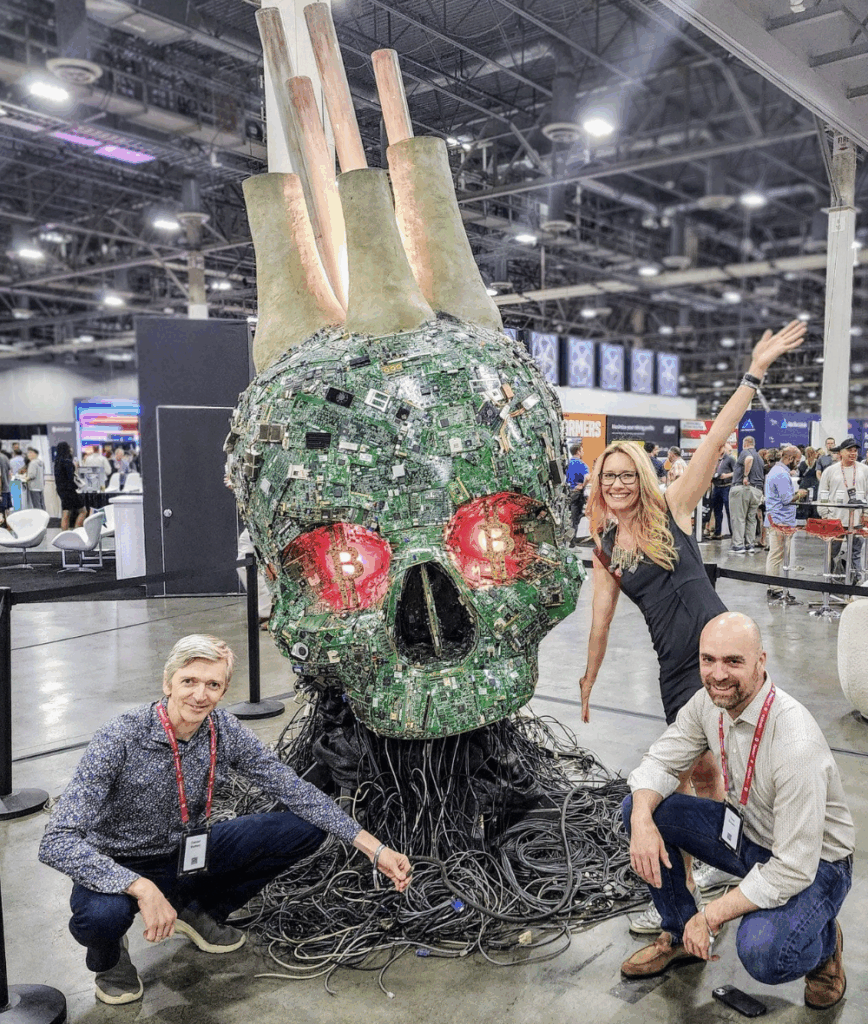
The impossible happens: The Skull of Satoshi finds its spiritual home at the 2025 Bitcoin Conference. With Mags Ramsey, Troy Cross and me.
How did this happen? I’ve asked this question before, and answered it in part here. There was undoubtedly a shift in the sheer number of positive usecases for Bitcoin. A large volume of papers and reports supported its environmental benefits. And after the China “ban” the network turned mostly sustainable-energy based. But this wasn’t the only reason the narrative changed, nor was it the most important reason. The reality is that the narrative had already started to shift before these third party validations started pouring in to hasten the retreat of Bitcoin mining’s antagonists.
The bigger reason is that an eclectic handful of people within the Bitcoin ecosystem stepped up and caused, indeed forced, this shift. There were many people: Margot Paez, Mags Ramsey, Susie Violet Ward, Willy Woo, Elliot David and others all played their part. One that I’ll highlight is Troy Cross because of the sheer volume of successful narrative-moving actions he took. He was the original catalyst for KPMG’s report on Bitcoin as an ESG asset coming out. He was the reason that Ben von Wong, the Skull of Satoshi creator, changed his mind about Bitcoin’s environmental impact (an unlikely turnaround that stunned GreenpeaceUSA). He did many other things behind the scenes that were even more impactful in changing the narrative. What were these actions? One day Troy may share. But that is Troy’s story to tell.
And yes, the data would suggest that I played an important role in this shift too.
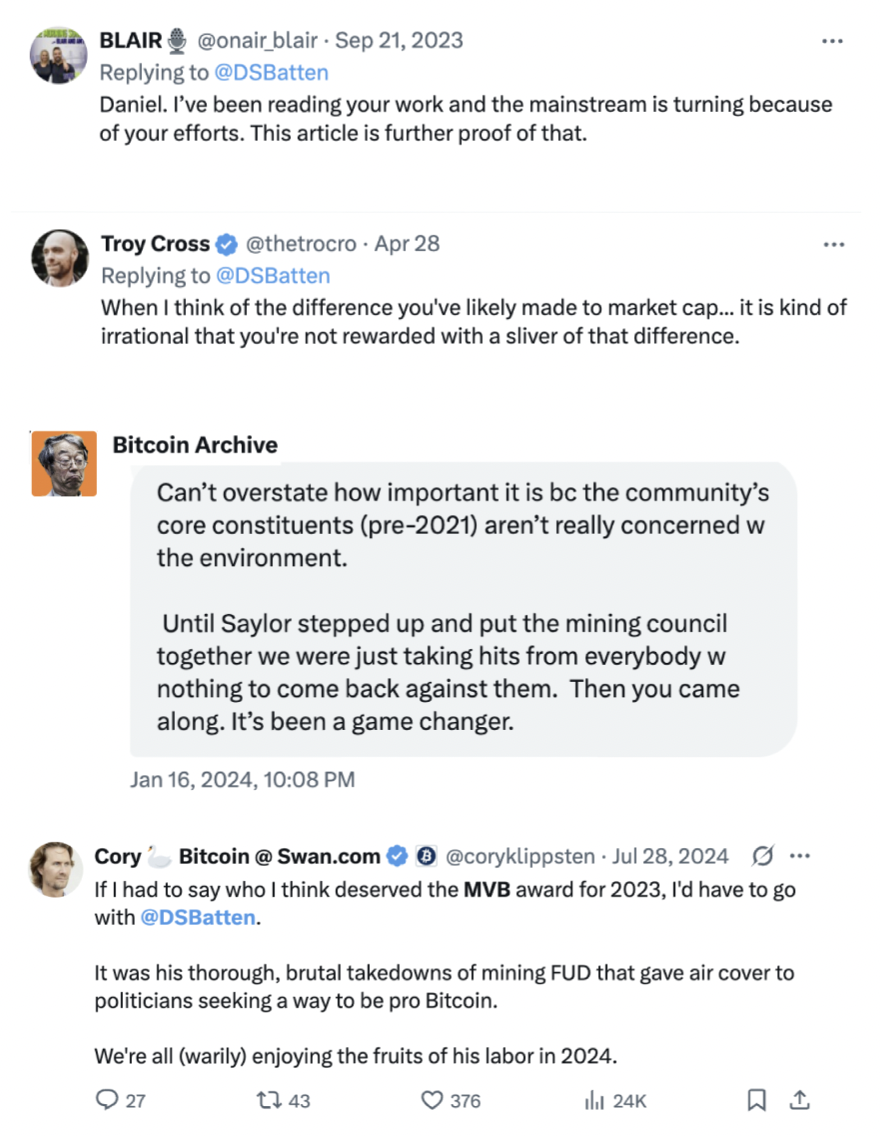
Though from my side, I was merely playing my part. If through my actions, something was accomplished it is only either because of something I was born with, or something that I learned through events and others. Either way, where is the “I” in this equation? All praise for the painting goes to the painter. This particular painting started some 34 years before Bitcoin’s whitepaper was conceived.
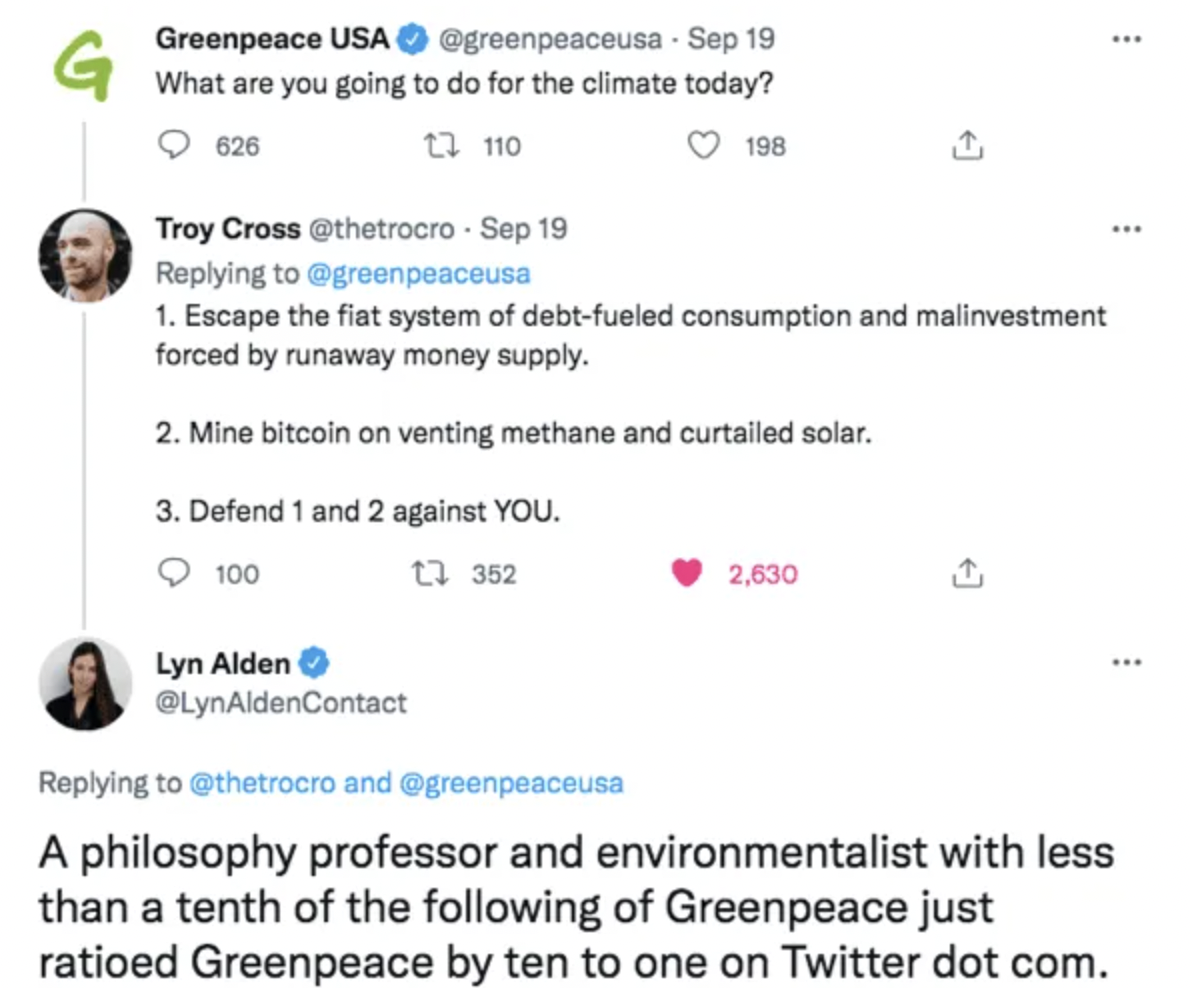
Direct, Highly informed. Biting. Troy Cross had one of the best senses for how to engage with those who attacked Bitcoin of anyone
The Furnace
“See, I have refined you, though not as silver; I have tested you in the furnace of affliction.” (Isaiah 48:10)
The time I was first socializing with other children coincided with the time I suffered chronic ear infections that rendered me not only chronically sick but almost unable to hear. Not a great combination. As a result, by age four, I couldn’t interact with other children at all. I’d missed the intuitive cues of conversation, and turn-taking that start to develop at this age. My mother was concerned. So she took me to be observed by a team of child psychologists who agreed I was well below average at socialization, and needed remedial training in how to communicate with kids at all. The training worked, though to this day unstructured conversation is still something that requires effort for me. But it also had some unanticipated benefits: I was learning how to communicate in a structured way much later than other kids. Because of that I was aware of the learning, and also very aware of the benefit of the learning. I could see how after my training, I was able to make friends for the first time in my life – and I knew, at age four, that learning to improve my communication had been the key.
The Second Furnace
Eight years later and much to my dismay, my school required us all to give prepared talks in front of our class every month. I hated those talks. I felt nervous, inadequate, and unconfident. I also felt the eyes of my peers judging my every inadequacy. As a result, I gave poor talks. But I’d already been through this experience of communication being pain – then experiencing relief from the pain. “What if there was a way to get better at this type of communication too?” I thought. That one thought spurred me to action. I knew instinctively because of my past experience that there was a way through this, I just didn’t have a team of psychologists to help me this time – I would have to do it for myself. I was better at science than speaking, so I put that left-brain to use and spent the next month trying to research my way out of my predicament. I studied the people who spoke well, and the ones that did not. I came to a surprising conclusion, the ones who spoke better were the ones who believed in themselves more. I wished I’d come up with a less intimidating conclusion because I believed in myself very little at that time in life – little wonder I was one of the worst speakers in the class. It was too hard for me to believe in myself though – I still felt like an outsider hoping for acceptance. But then I realized I didn’t have to believe in myself per se, I could leave that assignment for another day. For now, I only had to believe in my ability to get better at speaking. That I could manage!
The next month, I came top of the class. The next year I won the school speech competition. Twenty years later, I gave a particular type of speech called a pitch that helped secure investment for a technology company I’d co-foundered – kicking off the angel investment scene in New Zealand.
My obstacle was becoming my path.
Out of the furnace …
But this was not a simple natural progression from those early childhood challenges. There is a world of difference between being good at speaking and good at pitching. Those childhood insights, forged through the intellect, could only take me so far. I was still not connecting with the heart when I spoke. Nor was I engaging my intuition when I wrote. But the painter had apparently got that taken care of. At age 18 I was tricked by a family friend into meditating for the first time, something I had no interest in doing. But my experience was unexpectedly profound, and led to me travelling to India eleven times. The more I meditated, the deeper my intuition became. The more I practiced prānāyāma (breathing techniques) the higher my energy became and the more connected to my heart I became as I spoke: something which it turns out has a direct and surprising correlation to how investible someone would find a technology company! I also learned about something which would become an entire chapter in my book: non-attachment. Together these missing ingredients led to my first technology company finally finding investment.

By then intuition had assumed the drivers seat; the intellect a useful co-pilot. As I continued a never-ending cap-raise season in a country with almost no active tech-investment network at the time, I would often find myself pitching alongside other entrepreneurs. When I heard other people pitch, I noticed I could tell what was needed to get the result they wanted. I felt the same way I imagine a producer feels listening to a song and hearing what is needed to turn it into a #1 hit. Sometimes a single word would make me feel cold, or an intonation would make me flinch. Generally, the story was missing. Most pitches I heard were an ensemble of information: less “song”, more a series of notes with neither verse nor chorus. I coached one entrepreneur on their pitch. They ended up winning a prize at a pitching competition. This led me to had another realization: I enjoyed coaching others to run tech companies more than I enjoyed running my own.
So yet another bend in the path happened! In 2007, I found a new CEO to take over my company so I could step into the world of coaching. She was a naturally gifted communicator which made her a better leader than me in all respects … almost. Our next cap raise closed at a 44% discount to the last round I’d closed, even though she’d achieved outstanding business results that justified a much higher valuation. Time and again, I realized that this 40-50% number well described the minimum valuation discount that a public or private company would trade at if their message to the market was anything less than ultra-compelling and clear.
Ten years after that I was coaching other entrepreneurs full time. Despite most of the pitches I worked on being confidential, word started to get around that people who worked with me generally won their next pitch, across an increasingly diverse genre of songs.
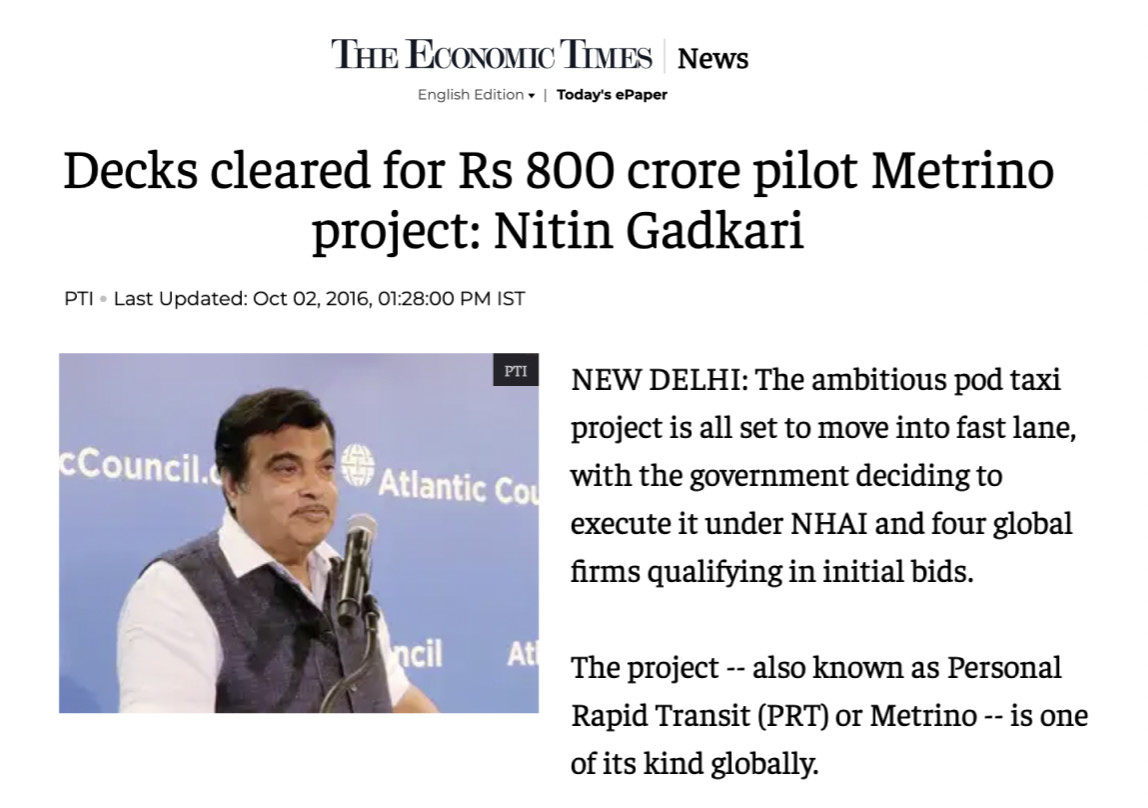
- An inventor of Metrino PRT, who’d spent 10 years looking for investment, got an agreement from the Indian Government for a $100 Million partnership to bring his technology to market
- A Center of Research Excellence won a fourth funding round of $48M (you were only allowed three)
- An angel investment group that only saw pitches from SaaS companies broke the rules to allow a deep-tech entrepreneur to pitch and then invested.
- An architecture firm who’d lost their last 3 pitches in a row and was about to start downsizing, then won the biggest contract in their history
- An entrepreneur who’d been brought in for last-minute training because his board saw he needed coaching, got the highest level of investor engagement on record for the event (332 investors wanting to progress to due diligence)
Over the next 10 years, I trained 52 founders of technology companies and 504 researchers looking to commercialize their work. One government agency wrote to me saying that my coaching work had helped “transform the research community [of New Zealand] at all levels.”
This is the first time I’ve shared all this. Why? For one thing, the work often had a multi-year confidentiality clause. But also, I still had the voice of doubt saying “Maybe they’d have achieved those things anyway?” Tenuous logic, given by then the founders I coached had won pitches more than six times as often the ones I did not across 24 cap raises. But as humans, we often reserve the most tenuous self-defeating logic for ourselves.
… and then came Bitcoin

Despite the successes, scaling the work faced obstacles. In an industry founded by experts in semiconductors and finance, the idea that upleveling a person’s narrative could make a difference to a company’s valuation was a concept that didn’t come naturally to many in the VC industry. Convincing them that it was the small hinge that swung the big valuation door was one pitch I did not win at the time. But again, the obstacle became the path. Rather than continue to try to convince VCs of the importance of founder coaching, I pivoted my approach, founding my own investment company, coaching every founder who we invested in. That turned out to be a good move not only commercially, but because it led me to Bitcoin.
Most of the investments I made were into climatetech, or impact investment, for a simple reason: I wanted to invest in things that would be positive for the world. So when one of my closest friends Willy Woo suggested that Bitcoin could be good for the environment, at the very time it was being lambasted by the media as being an environmental catastrophe, I was far from convinced. I now had very close friends in the environmental movement and in the Bitcoin ecosystem who were at loggerheads. I felt torn, but curious. And I made the same decision I made all those years ago at age 12, feeling terrified to stand up and speak: I would try to research my way out of the predicament.
That one decision changed everything.
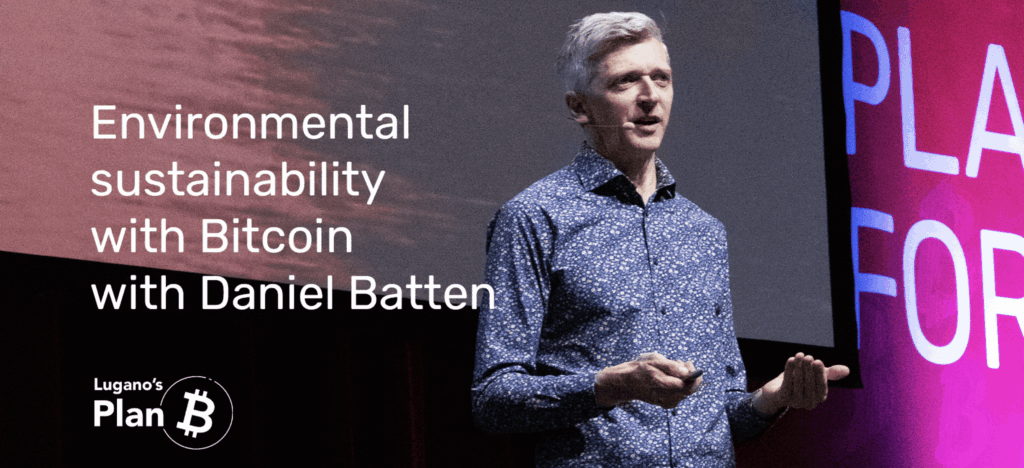
A year after knowing nothing about Bitcoin mining’s environmental impact, I found myself giving the opening Keynote about it in Lugano, Switzerland at PlanB Forum
For two months I did little else other than research Bitcoin mining. I read the articles from the attackers and the defenders of BitcoinFor two months I did little else other than research Bitcoin mining. I read the articles from the attackers and the defenders of Bitcoin. Bit by bit, I started to see the truth emerge from the fog of claim and counter-claim: Bitcoin was just like the solar industry for the first 40 years of its existence: it had a carbon footprint, but it also had a unique ability to pay off that carbon footprint. I learned about the claims made by Bitcoin mining proponents that it could stabilize grids, accelerate renewable energy expansion and even mitigate methane. I realized that this was not the greenwash that my colleagues in the environmental movement had dismissed it to be, but a legitimate way to counteract climate change across not one but many fronts.
But I realized something else that was even more important in terms of what happened next. I realized why no-one was listening to the pleas of most Bitcoiners and Bitcoin mining advocates. Their message was off, often badly so: defensive, self-justificatory, not speaking to the values of the attackers, too technical, easily dismissible as self-interest, lacking a memorable coherent counter-story, data-heavy but context-light, and yet ironically not well quantified enough in the areas it needed to be. These were just some of the problems. But because most of my work had been with smart technical people, I also knew how to solve these problems, and tell the story differently.
Did I want to though? Not really. The forces against Bitcoin mining were so strong, and so well funded, this would take a huge amount of time and effort – probably multiple years of volunteerism. And I knew it was way too big for me to do alone, no matter how much I knew about communication.
But then what happened next made the decision for me.
The Third Furnace
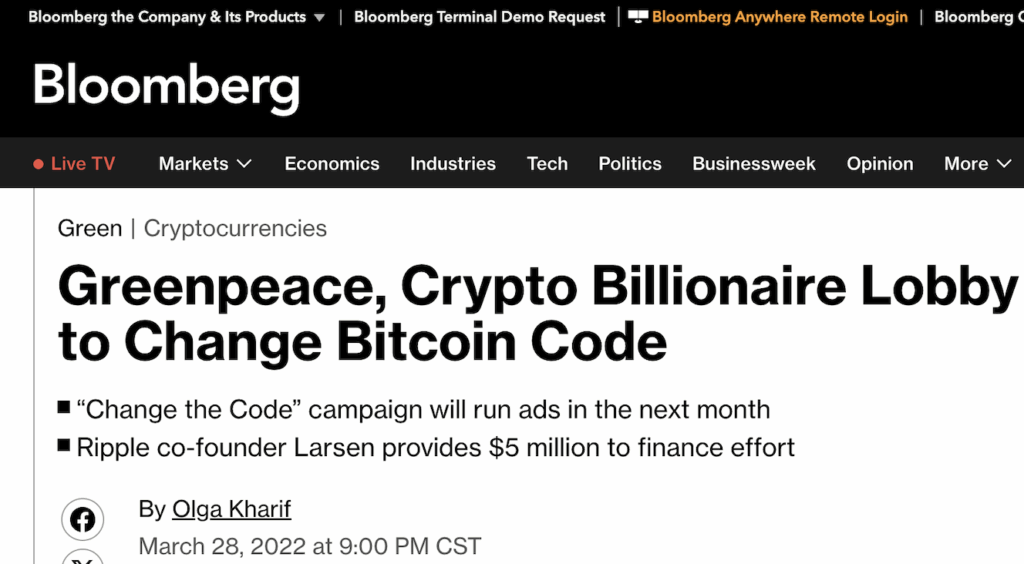
In March 2022, with the financial backing of a $5Million donation from crypto-Billionaire Chris Larsen, and the research backing of Central Bank employee Alex de Vries, GreenpeaceUSA launched their highest budget environmental campaign ever: a massive multi-pronged strategy to get Bitcoin to change its code to something that “used less energy”.
I remember the feeling of dismay that washed over me like a wave as I read one incorrect or misleading claim after another. How could an environmental organization have been so taken in by claims I knew from my research to be false, so quick to dismiss Bitcoin’s environmental advantages as greenwash that were not? How could they make the mistake that no environmental scientist would make of assuming that “high energy use” automatically meant “high environmental harm?” How could they not see there was evidence that the unique flexible type of energy use Bitcoin mining had was what we’d been looking for to make the green energy revolution possible? How could they squander resources fighting a technology the world needed more of?
By the time I’d finished reading I felt angry. But I also knew that this energy of anger, when transformed, would allow me to counter their campaign very effectively.
My Meditation Master had once told a gathering I was part of, “all negative emotions are just distortions of love. You love perfection, so you get angry at imperfection.” So before taking any action, I meditated. I felt that wave of anger transform into love: love for truth, love for the earth, and love for the positive potential for humanity that Bitcoin represented.
Then I wrote a single post that changed everything. I called out Greenpeace not with the attempt to shame or blame, but to correct a flaw in their perception. Having never written a tweet that got more than two likes ever, I never expected what happened next.
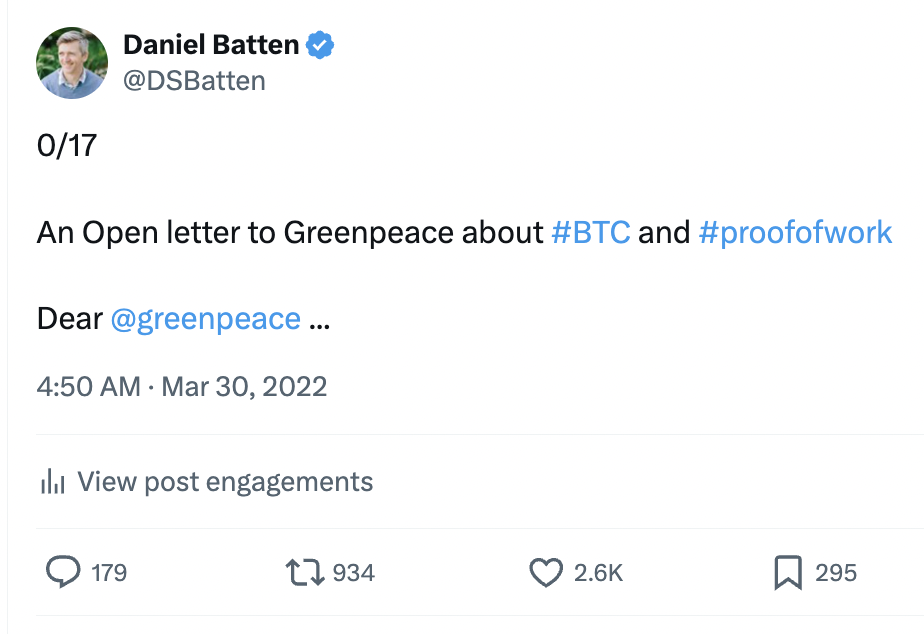
That one tweet got 617,000 views, resulted in invitations to podcasts and conferences, and announced me as a new voice in the Bitcoin community.
I felt like that child standing in front of the class, heart beating fast, about to speak once again. Only this time I wasn’t alone. I found myself engulfed by a hoddle of grateful Bitcoiners. Together we worked as a loosely coordinated decentralized pod to incredible effect. We not only took down GreenpeaceUSA’s multi-million dollar campaign armed with nothing but the truth and our collective sense of being David against Goliath, but we beat back every reputable environmental voice that tried to attack Bitcoin. For my part I deflected their false claims with data, flummoxed them with facts, pummeled them with politeness, and confused them by being myself: an environmentalist who liked Bitcoin. I relentlessly and respectfully reflected back their case for why they thought Bitcoin was bad better than they had articulated it, pointed out the gaps in their reasoning, challenged their sources, where possible got around “their side of the table” and didn’t just stop at defending Bitcoin but explained why as an environmentalist and climatetech investor I was excited about it.
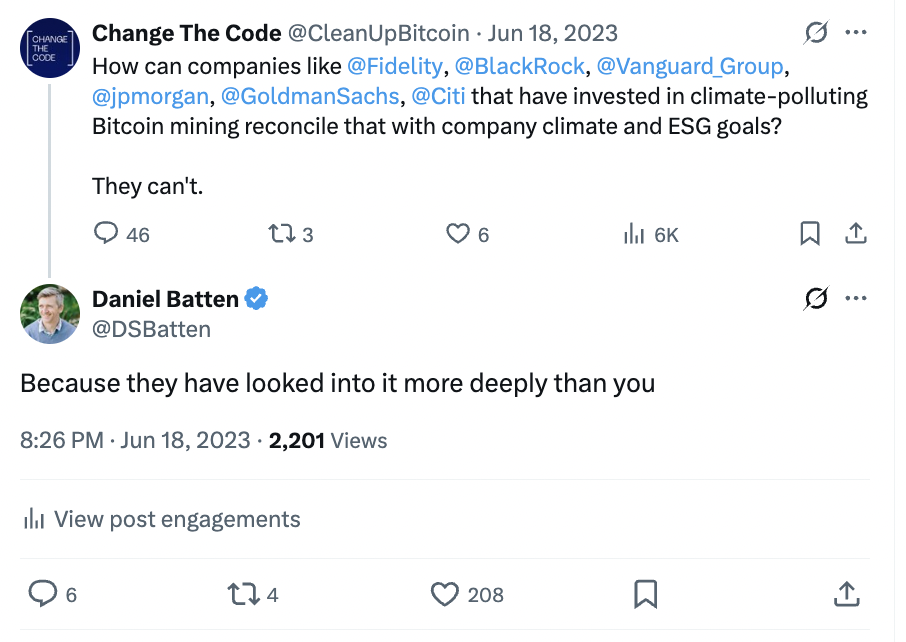
Every day, when the Change The Code handle posted anti-Bitcoin tweets, I replied with respectful facts, correcting the inaccuracies. Each time GreenpeaceUSA posted against Bitcoin, I called them out for squandering their resources and revealing the dangers of environmental activism divorced from environmental science.
It is still five years too early to pull back the curtain on most of the strategies and messaging tactics we used. But one thing I can reveal (for the first time) is how the KPMG report Bitcoin’s role in the ESG imperative came to be.
KPMG’s report came out thanks to Troy’s vision to have a reputable independent voice analyze Bitcoin’s ESG credentials. He initiated the dialogue and connected all the right people. Behind the scenes however, KPMG’s ESG director was very uncomfortable about publishing anything about Bitcoin mining. Firstly because this was not the prevailing wisdom of the time, and secondly because he’d read a lot of the same sources that Greenpeace had and had genuine concerns. I ended up in a series of rapid-fire email exchanges where his (many) well articulated objections were met with my evidence-based responses. It was always a long shot, but miraculously he changed his mind, and the report was published. We now had our first weapon that independently endorsed Bitcoin’s ESG benefits. GreenpeaceUSA was livid. KPMG later told us that GreenpeaceUSA had contacted them directly, and used a number of activist tactics to try to get KPMG to retract the report. But we knew GreenpeaceUSA’s arguments against Bitcoin very well, and had already shown KPMG why these arguments were invalid: KPMG stood firm. The truth was starting to win.
Slowly but surely the tide started to turn. At the end of 2023 I met with the head of GreenpeaceUSA’s campaign, and found out that he’d read each response to every post I’d made on Twitter. “I wish we’d engaged with you and people like you from the outset” he admitted. Two months later, he left Greenpeace. A few months after that GreenpeaceUSA ended their campaign – both the most well-funded and the most disastrous result in their history. Without them, other environmentalists who had been anti-Bitcoin quickly beat a hasty retreat. Some deleted previous anti-Bitcoin posts like Y2K project managers deleting that line from their CV in 2001. Others changed their minds, some kept their well-entrenched anti-Bitcoin position but no longer vocalized it: they knew the Overton Window had shifted and they could not venture their viewpoint with impunity outside a safe circle of the likeminded.
For me, it was by far the biggest and most hard-won pitch to date. Two years of work every day, while watching my coaching business dwindle in size as my focus was 100% on this mad, crazy, impossible campaign to change public perceptions of Bitcoin mining, with no plan, no budget, no hope of success and up against Billionaires on one side and Central Banks, Governments and the entire mainstream Media on the other. But it was also one of the most rewarding experiences in my life.
Until that time I’d wondered if the work I’d done was only effective with founders of early-stage technology companies and a handful of others. I now find myself coaching CEOs of listed Bitcoin Treasury Companies, Bitcoin influencers, multiple-exit entrepreneurs now working for Bitcoin, and some of the world’s top business coaches – who coach UHWNIs and CEOs of Fortune500 companies. I’ve also coached Bitcoin founders to get funding, and have helped a few intrepid Bitcoin changemakers to set up Bitcoin Policy Institutes in their country or state. Four times I’ve gotten messages from people telling me they’re using my messaging to help show a head-of-state the environmental benefits of Bitcoin mining. Last week a Bitcoiner even said they’d used my book on pitching to prepare for a presentation to 40 principals of Family Offices.
The “Multi-year pitch to help change environmental narrative on Bitcoin” is largely complete. I don’t know what my next assignment is. But whatever it is, after what I learned as part of the team that shifted the environmental narrative on Bitcoin I no longer feel fazed. If an AI company asked me to counter the new batch of research that de Vries is writing about the environmental issues with AI, I would know what to do. If a large company asked me to articulate their equity narrative better so their stock valuation lifted, I would know what to do. If someone wanted help orange-pilling the world’s financial regulators about the Bitcoin, well … I’ve started doing that and they are responding positively, so apparently I know what I’m doing there also.
I’m still average at holding a conversation. I definitely prefer to coach others to greatness rather than lead from the front myself. But sometimes I’m called on to lead as well as coach – and as uncomfortable as that makes me – I’ve learned not to surrender to whatever the painter has in mind for me and simply play my part to the best of my abilities. It seems as long as we recognize and use our gifts to do something good for the world, things have a funny habit of working out. Even when the path is not clear. Nay, especially when the path is not clear! As the proverb goes … the obstacle is the path.