Question:
If an interviewer feeds the interviewee the line “there are these billion dollar companies that are profiting off the back of these poor working people”, we can reliably assume that their work is something other than investigative journalism.
Welcome to the world of funded narratives that are made to look like investigative journalism.
In June 2025, Dan Lieberman approached me asking if I would be interviewed for an “in-depth video report for More Perfect Union on bitcoin mining in Texas”. He promised that he hoped to meet “bitcoin mining operators, grid energy experts, policymakers and residents to hear from folks on all sides of the issue.”
He referred me to his earlier work, which I watched. It was then and there that I decided I wanted no involvement. I politely declined, citing my discomfort with the “industrial villain vs disaffected community framing” that he’d used in a previous video of AI datacenters vs the community, where he’d made a number of non-fact based claims including the false claim that AI datacenters put up the price of energy.
When I watched his video (and yes the line “there are these billion dollar companies that are profiting off the back of these poor working people” is taken verbatim from his video where he appeared to ask a series of leading questions to elicit the response he wanted from those he interviewed), I was relieved about my decision.
As with the AI video, there were no interviews with energy experts, no interviews with bitcoin mining operations, and no attempt to show “all sides of the issue”. Rather, the video appeared to me to be more of a continuation of the vilification of industry, and presentation of communities as disaffected and powerless victims.
The question is, why would someone go out with an agenda to make one industry after another look as bad as possible by ignoring all evidence of community benefit and presenting carefully selected material around an outlier (and yes, every industry and indeed group of people has outliers)?
The clue can be found in the funding source.
More Perfect Union is an activist-based company founded by former Bernie Sanders staffers. It specialises in presenting narratives that paint community as victims and big business as perpetrators. AI and Bitcoin mining were not the subject of investigation, but rather chosen to play a part that suited the intentions of the organization. As such, the “reporter” in this video interviewed other activist organizations, founder of an anti-bitcoin group in Texas, and Mandy deRoche – who is a paid lobbyist for activist organization Earthjustice. To be clear: deRoche, who is quoted widely, specializes in the anti-Bitcoin leg of Earthjustice’s work. She has previously been associated with putting out a lot of environmental misinformation about Bitcoin, which has subsequently been debunked in over 20 peer reviewed publications and by Cambridge’s recent 4th Bitcoin Mining report. I have previously covered the misinformation put out by Earthjustice on this site. Earthjustice has made no attempt to retract earlier reports as peer reviewed evidence disproved them, but rather has pivoted from one false claim (“Bitcoin reopens fossil fuel plants”) to another (“Bitcoin uses too much water”).
The irony is that Bitcoin mining has proven to have innumerable community benefits, which disproportionately help the working class, the very people that More Perfect Union claim to stand in support of. Around the world, the picture is even more stark: Bitcoin has proven time and time again to help the most marginalized, the poorest and the most vulnerable citizens of the world. This video however gave a wide berth to any sincere attempt to portray Bitcoin’s widely documented benefits to the environment and communities. Just this July, The Digital Assets Research Institute found that 329,000 refugees, some of the world’s most vulnerable communities, had been able to set up in a new country using bitcoin that they had taken with them across borders. In Rockdale Texas, Local mayor Ward Roddam said that Bitcoin mining had “saved the community of Rockdale”, particularly blue collar workers whose lives and livelihoods had been negatively impacted by the outsourcing of manufacturing. Here’s an excerpt of him talking publicly to a local newspaper article about the benefits of Bitcoin mining to blue collar communities.
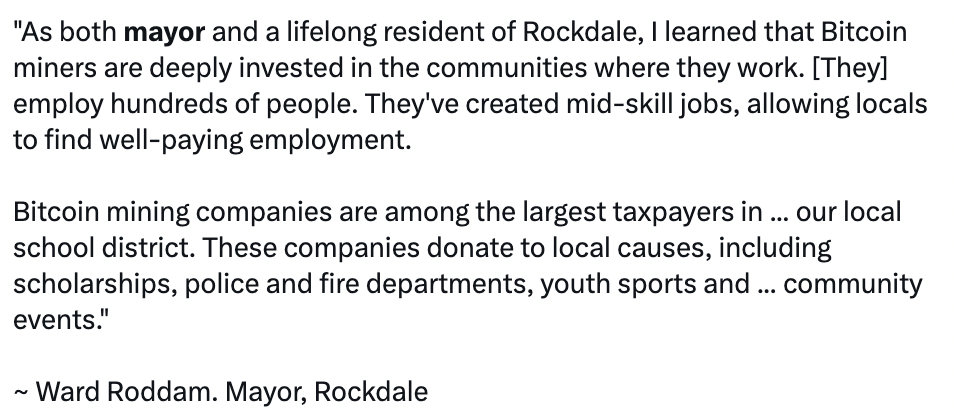
The narrator of this video travelled to Rockdale, so it’s not as if he didn’t have the chance to do a balanced presentation, or was operating in ignorance. He must have decided that the Mayor would not make a good interview subject.
Let’s look at some of the more glaring issues with the video
- Dan levels the same factually incorrect statement he earlier made about the AI industry: that the Bitcoin mining industry “Drives up energy costs”
Not only is there no evidence, either real-world or in the academic literature for this claim, but there is a significant body of evidence to the contrary. For example, Brad Jones, Former CEO of Texas’ grid ERCOT observed that by creating a more competitive market for ancillary services and by finding a home for otherwise wasted wind energy, Bitcoin was “helping keep the cost of electricity low for all Texans”
In Sept 2024, Norwegian residents realized that Bitcoin mining had for years been keeping their power prices 20% lower, after the Bitcoin mining operation left the grid and their prices instantly increased as a direct result to meet the revenue shortfall.

This coupled with the ability to be located anywhere, the Bitcoin mining load is one of the most cost effective ways to provide DR, FCAS and System Strength services. It also incentivises overbuild of renewables. Bitcoin miners are also building plenty of energy assets globally.”
Further, Inflation-adjusted figures show no statistically significant rise or fall in either electricity or gas prices since Bitcoin mining came onto the ERCOT grid in Texas, giving support for ERCOT CEO Brad Jones’ observation that Bitcoin mining in fact “Helped keep the price of power low for all Texans.”
The claim therefore seems to be a false attribution of the impact of high inflation from 2021-2023, to Bitcoin mining.

2. Bitcoin mining companies were involved in “price gouging” during Winter Storm Uri, “They held on to energy. They sold it at a profit during a crisis”. The opposite is in fact true. Bitcoin mining companies provide a vital grid stabilization service called “Demand Response” which other users such as steel plants and aluminum smelters participate in.
Demand response is a critical example of “ancillary services” which grid operators use to stabilise grids and has existed well before bitcoin mining did (Demand Response has been around for roughly 40 years).
The entry into the demand response market of bitcoin mining means more suppliers compete for grid owners’ demand response revenue, making the demand response market more competitive and lowering the total cost of demand response payments made by grid owners. Brad Jones, former interim CEO of Texas’ grid confirmed “the capability [of bitcoin] to meet our ancillary services means lower cost for all consumers in the state of Texas.” Jones also confirmed that crypto-mining helps “balance our grid more efficiently” because of their unique ability to shut off quickly, when compared to other industrial loads offering demand response services.
As energy expert and Bitcoin mining operator Dr Tom Algie puts it
“Turning off and providing demand response isn’t straightforward. Compensation for traditional DR assets; steel works, aluminium smelters etc, is astronomical. Bitcoin mining revenue is on par with electricity prices, so we don’t need much additional incentive to turn off.
As such, Demand Response further helps lower electricity prices.
3. “impacting communities water supply” there is no evidence for this statement. The myth was perpetuated by a short commentary by Alex de Vries in 2023. The interview subject is engaged in conjecture “The new bitcoin mining operation could use this lake”, with no evidence. The work of de Vries has now been debunked in multiple peer reviewed studies including Lei et al, 2019 and Sai and Vraken, 2023.
4. Every $100M that one of these companies extracts from the energy market is paid by me and other Texans” Adrian Shelley. This is false, as evidenced with the real life case study from Norway above. It also betrays a lack of astuteness about how electricity pricing works. More users paying for energy results in higher profits for the grid operator, and less pressure to put up prices for residential users.
5. “there is increased fossil fuel generation in their community” (Mandy DeRoche) “There’s air pollution, there’s water pollution”. There is no contemporary evidence that bitcoin mining supports fossil fuel generation, and substantial counter-evidence, including Cambridge who found that Bitcoin mining is 52.4% sustainably powered. This incentivizes more green energy development according to multiple peer reviewed studies.
6. General tone: Bitcoin mining is misrepresented as a technology with no value other than speculation. This is again widely disproven, with 19 social and environmental use-cases being well documented.
In terms of the noise issues: the readings that were shared appeared to be historic. There was no evidence provided that the sound levels currently exceed the legal limit. Nor is there evidence that the sound comes from the Bitcoin mining units. There are also 3 Gas plants adjacent, which are very loud, and have a known “valve blow“. The Guardian had also previously shown a video, clearly showing “valve blow” (even named such by the resident filming it), but falsely attributing it to the Bitcoin mining facility.
Overall, the video offers nothing new that hasn’t already been claimed by Time Magazine a year ago, and hasn’t already been countered in my earlier rebuttal of Time Magazine’s article.
The impact of Bitcoin mining on rural communities in US has indeed been significant. The narrator got that part correct. Aside from keeping the cost of energy low and helping communities decarbonize, Bitcoin was found in a recent report from Perryman Group to
* create 31,000 jobs
* stabilize electric grids
* invest into their local communities
source
Matt Schultz from Cleanspark recently shared that these community benefits extend to”employing locals” and even pushing down property taxes”
In the decade-long history of bitcoin mining, have some residents in some cases been negatively impacted by noise from Bitcoin mining operations? I would be very surprised if they have not. No industry is perfect. I have visited multiple bitcoin mining operations. There is no doubt that older air-cooled mining rigs (becoming less common) are very noisy. The four Bitcoin mining sites I saw were all located far from residents with no sound issues. The problem is that videos like this one actually do more harm than good to the community, because in trying to use a community for political leverage and having an intentionally one-sided treatment, it becomes hard to trust any of the content of such videos, and the community’s real voice is lost. What we need is quality independent documentary-making that tells the community’s story without bias and agenda. This was clearly never the intent of this video, nor this video-maker.
Adenda
Some more context on More Perfect Union
A quick scan of their prior Youtube content, and funding sources reveals that the organization
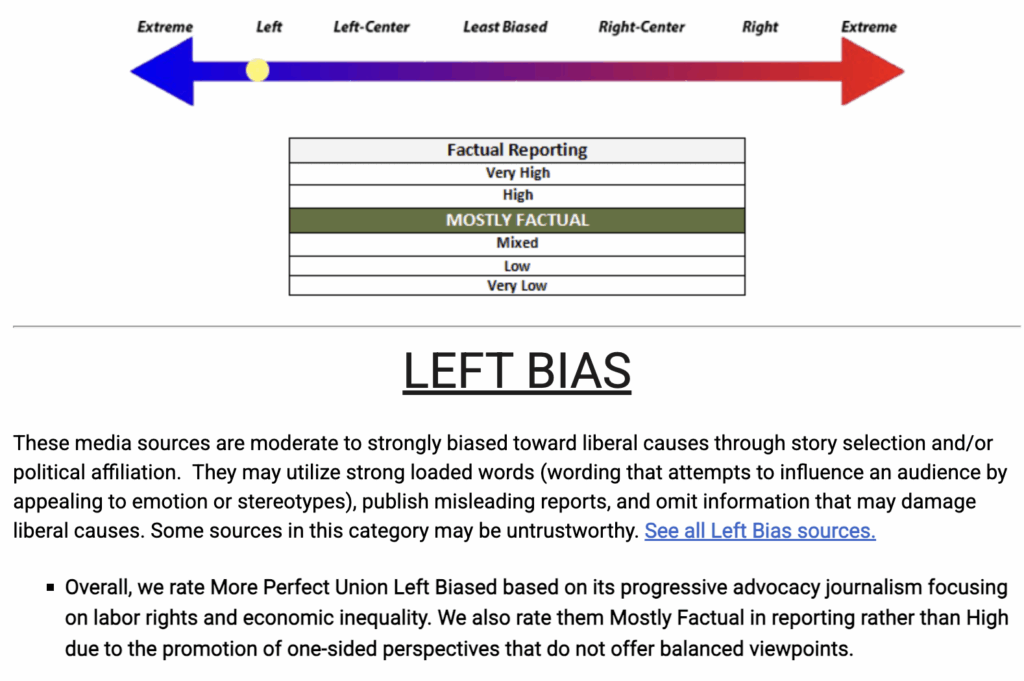
- Media Bias/Fact Check rates More Perfect Union as Left Biased, noting “one-sided views that lack balance” and a tendency to “publish misleading reports” and
- Has regularly been accused of activism disguised as journalism
- Often omits counterarguments or industry perspectives in its reporting.
- Uses emotional storytelling to push a specific political agenda.
- Their tone is “Advocacy-first”, openly partisan
- Non-transparent funding: donations are often channeled through ActBlue-funded groups (a Democrat party funding platform). Other funders likely include unions, grassroots donors, and left-leaning foundations (exact details unclear).
- MPU represents a growing trend of “movement journalism”—outlets that combine reporting with explicit political goals. This style of “reporting” has received criticism for sacrificing objectivity and risking cherry-picking data to suit a predefined industry vilification narrative in the process.
- Content: focuses on Labor movements, strikes, union organizing, critiques of capitalism, corporate greed, income inequality