It’s 2026, and many people still say Bitcoin has no use cases. If you’re from the West, that view is understandable: most of Bitcoin’s highest-impact uses are in places few Western readers ever see.
I’ve spent some time thinking about why this still happens, and I see three main reasons.
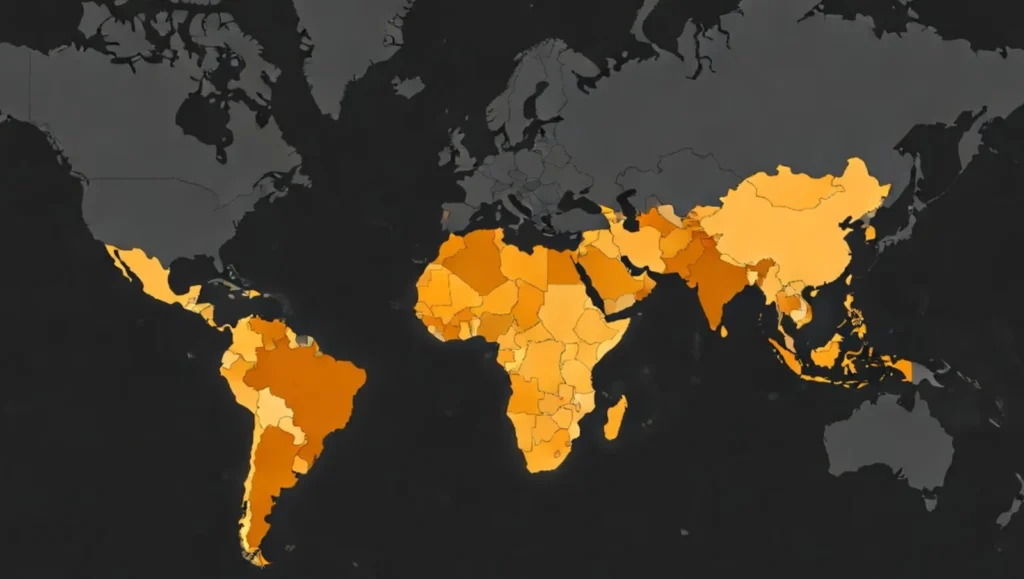
The first is an honest one: most of Bitcoin’s highest-impact use cases are in the Global South. Remittances, inflation protection, financial access for the unbanked, resistance to monetary colonization. If you live in the West, these problems are invisible to you. They don’t make your evening news. You’ve never had your savings halved in a year by your government’s monetary policy, and nobody you know has ever paid 15% to send money home to their family. So when someone says “no use case,” what they often mean is “no use case that affects me personally.” That’s a statement about their field of vision, not about Bitcoin.
The second is human nature. Many people looked at Bitcoin early and decided against it, and it’s natural to hold on to a view we formed early.
The third is more interesting. Bitcoin may be the first major technology in modern history where utility reached the developing world before the developed world. That’s the reverse of almost every technology adoption curve we’ve seen. The internet, mobile phones, electricity, antibiotics, all started in the West and diffused outward. Bitcoin went the other way. It found product-market fit first among people whose currencies were failing, whose governments were seizing assets, whose banking systems excluded them. The West will be last to understand Bitcoin’s utility, because the West is last to need it. That’s an unusual position for societies used to adopting new technologies first.
As a technology investor, I look at Bitcoin as I do any technology: with initial skepticism followed by due diligence before making an assessment. I’ve probably seen thousands of technologies over the years, and been pitched hundreds of times. The result of my due diligence on Bitcoin is that only three software-based technologies stand out as genuinely transformational to society at large over the last 30 years: the Internet, AI and Bitcoin.
Like the Internet in 1994, most people aren’t aware of how Bitcoin will transform society yet. So here’s a list of 21 uses you probably aren’t aware of that have already emerged and achieved scale.
This is just the start. Like the Internet, I expect many more uses to emerge as more people understand what Bitcoin makes possible.
I have excluded from the list theoretical “one day” use cases. This list contains only real-world examples of Bitcoin already being used at scale today.
21 Bitcoin use cases already working at scale
- Allowing refugees to re-establish a life with their savings intact (329,000 people so far impacted) (DARI)
- Providing banking to the unbanked (2 billion people potentially impacted) (CNBC)
- Reducing the risk of financial reprisal for running humanitarian campaigns in nations under autocratic rule (4.5 billion people potentially impacted) (BBC)
- Getting aid to tens of thousands of war refugees in Ukraine, Gaza and other areas (CNBC)
- Offering an alternative for the 14 African nations whose currency, the CFA franc, is pegged to the euro and backed by the French Treasury (Foreign Policy)
- Allowing 4.1 million merchants (mostly small business owners) to receive payment without high Visa/Mastercard fees (Fidelity)
- Allowing hundreds of millions of people in developing nations to receive remittance payments from family without delays and without heavy fees (The Next Web)
- Preventing fraud and ballot tampering in Guatemala’s 2023 election (17.3 million people impacted) (Bitcoin Magazine)
- Helping Afghan women avoid state-level financial discrimination (20 million impacted) (Bitcoin Magazine)
- Protecting family savings from 50%+ annual inflation in countries with hyperinflation or high inflation (250 million+ potentially impacted) (Cointribune)
- A way to save that anyone can use, at any hour, in a money whose supply can’t be increased (Bitcoin.com)
- Used far less for money laundering than cash and bank transfers, according to the US Treasury’s 2024 risk assessment (US Treasury)
- A fixed-supply money that no central bank can expand, avoiding the wealth gaps that loose monetary policy has widened (Karen Petrou’s Engine of Inequality)
- Enabling renewable microgrids to deliver electricity to 28K rural villagers in Africa (potential impact: 600 million) (BBC)
- Helping keep Virunga, Africa’s oldest national park (7,800 sq km), running, in the words of its director (MIT Technology Review)
- Developing energy independence for nation-states, such as Bhutan (Forbes)
- Allowing nations such as Ethiopia to accelerate building of infrastructure to rural areas currently without electricity (affects 600 million people in Africa) (Al Jazeera)
- Reducing emissions from landfills (Renewable Energy Magazine)
- Having a monetary system with significantly lower emissions intensity than the banking system (Cambridge, Ember)
- Accelerating the renewable transition by increasing the profitability and reducing the curtailment of renewable generation (Cornell University)
- Reducing the time it takes utility-scale solar generation facilities to achieve ROI from 8.1 to 3.5 years (Heliyon)
Next time someone tells you Bitcoin has no use, share this list with them.